Loading...
← Back to Mega Fauna Index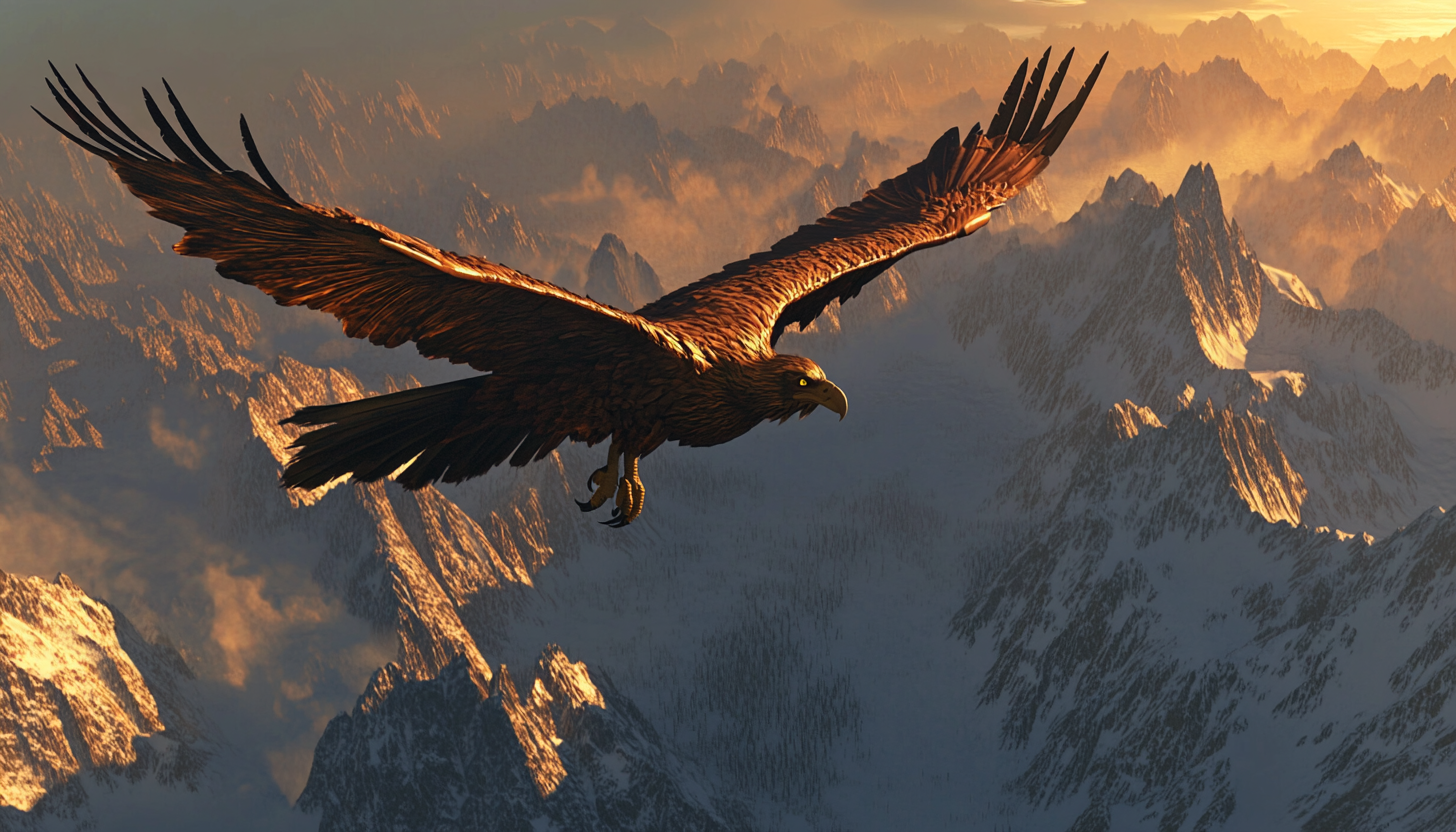
Roc
Avis titanicus montanus
Apex Aerial Predator - High Mountain RangesA Roc surveys its mountain domain - those few who have survived direct eye contact speak of being "measured and weighed" by a predatory intelligence.
In the vast unexplored territories of Aethoria, where the eastern mountain ranges scrape the sky and the air grows thin, dwells one of the most magnificent and terrifying creatures known to scholars and adventurers alike: the Roc. These colossal birds of prey stand as nature's challenge to dragonkind, having evolved in parallel as apex predators of the highest mountain ranges.
Physical Characteristics
A mature Roc stands taller than three men when perched, with wingspans reaching eighty to one hundred feet across. Their massive beaks can shear through the hide of a fully grown Oliphant, while their talons—each the size of a shortsword—can puncture even the armored shell of a Sandshell. The feathers covering their bodies appear in shades of russet, gold, and white, often darkening to nearly black at the tips of their wings and tails.
The most remarkable feature of a Roc, beyond its sheer size, is its eyes. Large as dinner plates and gleaming with an intelligence that belies their bestial nature, Roc eyes possess a golden-amber hue that seems to catch and hold sunlight even in the darkness. Those few who have survived direct eye contact with a hunting Roc speak of feeling "measured and weighed" by a predatory intelligence that calculates the exact effort required to end their existence.
Habitat and Territory
Rocs make their nests at the highest elevations, typically above fifteen thousand feet where even the hardiest mountain goats rarely venture. Each mated pair claims a hunting territory spanning hundreds of square miles, with boundaries respected by even territorial dragons. Their aeries are massive constructions of intertwined trees, boulders, and the bones of large prey, often built into the face of a cliff or mountain peak.
The air around a Roc's nest carries a distinctive scent—a mixture of ozone, like the air after a lightning strike, and the musk of large predatory birds. Experienced mountain guides in the Eastern Ranges can detect this scent from miles away, using it as a warning to avoid particular valleys and passes where hunting Rocs might patrol.
Lifecycle and Behavior
A mated pair of Rocs typically produces a single egg every three to five decades. This egg, larger than a wine barrel and mottled with patterns unique to each lineage, requires nearly a year of incubation before hatching. Young Rocs grow quickly, reaching the size of a horse within their first year, though they remain dependent on their parents for food and protection until their fifth year.
Unlike dragons, Rocs lack magical abilities but compensate with physical prowess and hunting intelligence that rivals the most cunning predators. They hunt primarily at dawn and dusk, using the rising or setting sun to blind their prey as they dive from staggering heights. Their primary diet consists of mountain goats, wild cattle, and occasionally Woolbacks that stray too far from protected trade routes.
Cultural Significance
Among the Mountain Clans of the Eastern Ranges, the Roc holds a place of reverence second only to Durathor himself. Clan shamans interpret the flight patterns of distant Rocs as omens, while hunters who find a naturally shed Roc feather are considered blessed for a season. The clan that successfully retrieves a Roc egg without harming the parents—a feat accomplished perhaps once in a generation—names their chief's successor after the patterns on the shell.
Guild Advisory
The Adventurer's Guild classifies Roc encounters as Exceptional Risk Events, requiring a minimum of a full champion-level party for any contract involving these creatures. The standard protocol for peaceful passage through Roc territory involves burning special incense made from mountain herbs that signals non-threatening intentions. If a Roc's hunting attention is attracted, Guild training recommends immediate dispersal and seeking dense forest cover or narrow cave systems.
Information compiled by the Imperial Academy of Natural Studies, with contributions from the Mountain Clans' Oral Traditions and the Eastern Ranges Cartography Guild.