Loading...
← Back to Mega Fauna Index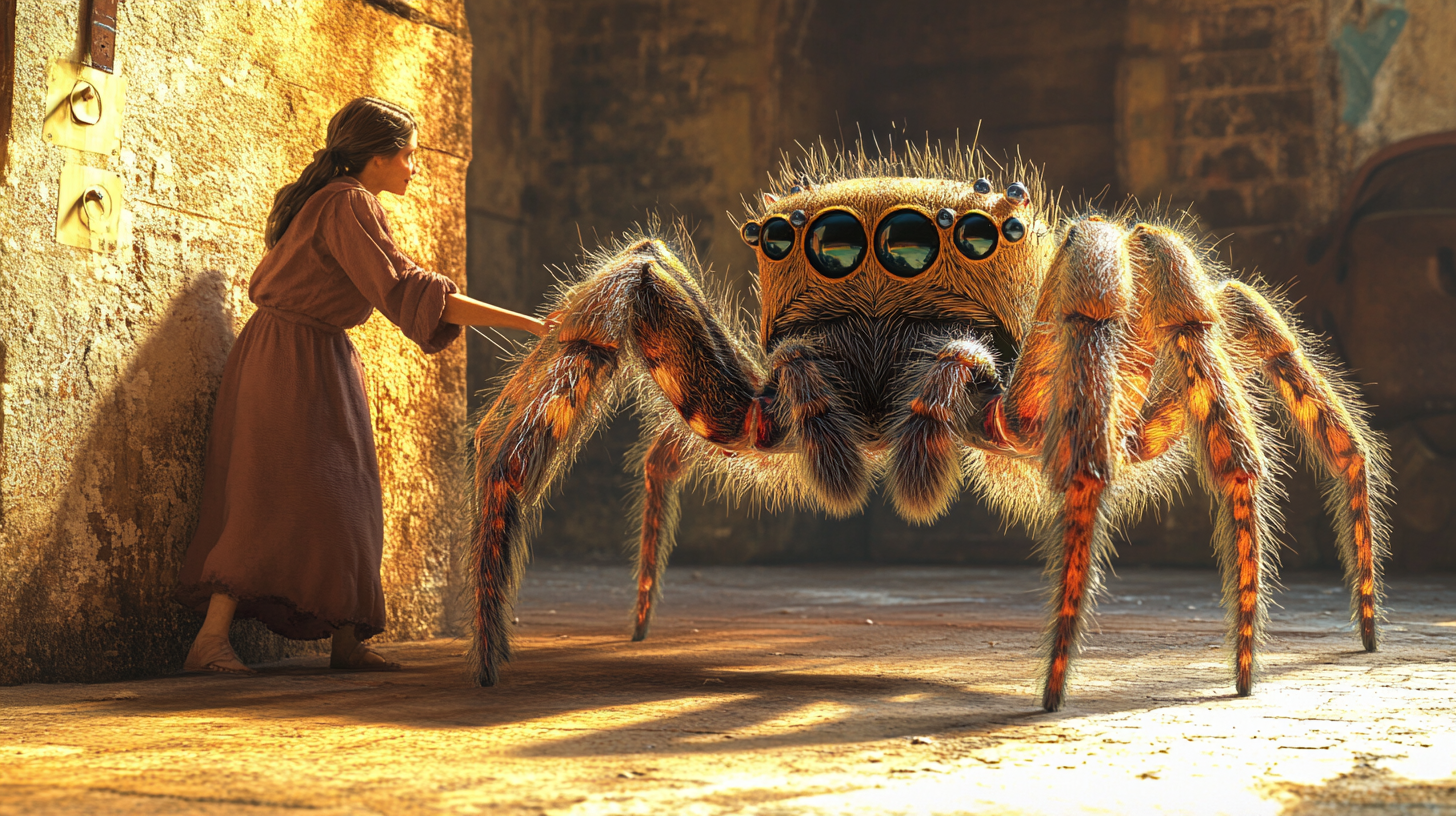
Tamed Acromantulas
Arachneus domesticus
Domesticated Partner - Various RegionsA tamed Acromantula works alongside its bonded handler - a partnership that begins at hatching and lasts a lifetime.
Unlike their wild cousins whose predatory instincts make adult domestication impossible, Tamed Acromantulas represent one of humanity's most unusual and remarkable partnerships with the natural world. These giant spiders, raised from carefully collected eggs and bonded with handlers from the moment of hatching, develop into loyal, intelligent companions that serve in roles ranging from guardianship to specialized labor.
Origins and Breeding
The practice of Acromantula domestication arose from the discovery that eggs collected from wild nests and incubated under human care produce spiderlings that imprint on their handlers rather than their own kind. This critical bonding period occurs within the first hours of hatching, when the newly emerged spiderling recognizes the first large creature it encounters as its "colony parent."
Licensed breeding facilities maintain careful records of lineages, selecting for temperament, trainability, and health. Wild egg collection is strictly regulated by the Adventurer's Guild and Handler's Association to prevent overexploitation of wild populations and to ensure only viable eggs are taken - typically one or two from nests containing dozens.
Physical Characteristics
Tamed Acromantulas share the impressive dimensions of their wild relatives, standing 6-7 feet tall with leg spans of 8-9 feet and weighing 800-1,200 pounds. However, generations of selective breeding have produced specimens with more expressive body language, enhanced sensory hair coloration (allowing handlers to read their emotional states), and slightly reduced fang size - still formidable but less prone to accidental injury.
Their venom production is modified through training and diet to be non-lethal to humans while retaining effectiveness against genuine threats. The distinctive patterns on their carapaces often develop unique markings that handlers learn to read as individual "expressions."
Training and Bonding
The training process begins at hatching and spans 3-5 years of intensive handler interaction. Young spiderlings learn communication signals - a complex system of vibrations, postures, and touch commands that allows nuanced two-way communication between spider and handler. The bond formed during this period is permanent; tamed Acromantulas recognize and respond only to their designated handlers and a small circle of approved individuals.
Training focuses on impulse control, situational awareness, and task-specific skills based on intended roles. Advanced training develops problem-solving abilities, patrol patterns, and controlled web construction for various applications.
Roles in Society
Tamed Acromantulas serve in numerous capacities across Aethoria. As guardians, their ability to sense vibrations and detect intruders makes them exceptional security for important facilities and warehouses. Their web-spinning capabilities are employed in specialized construction, rope-making, and the creation of unique textiles. In search and rescue operations, their ability to navigate collapsed structures and sense living beings proves invaluable.
Some specialized military units employ Acromantula mounts for reconnaissance and ambush operations, though this practice remains controversial. More commonly, they serve as working partners in environments too dangerous or inaccessible for humans alone.
Handler Certification
The Acromantula Handler's Association maintains strict certification requirements. Prospective handlers must complete a three-year apprenticeship before being matched with a spiderling. Only certified handlers may work with tamed Acromantulas, and the Handler's Registry tracks all bonded pairs. Unauthorized attempts to acquire or handle these creatures are criminal offenses under Guild law.
Information compiled by the Imperial Academy of Natural Studies, with contributions from the Acromantula Handler's Association and the Adventurer's Guild Exotic Species Division.